
The past often holds a cherished beauty. Old art is treasured for its cultural value and historical significance. The challenge nowadays is how to revive old art by encouraging more young people to understand and like it.
The Hong Kong-style Cantonese Opera or “Daai Hei” (香港大戲) has been a unique form of performing art in Hong Kong for more than 100 years. It is the most important intangible cultural heritage of our international city. While flourishing at its peak in the 1950s and 1960s in Hong Kong, Cantonese opera in the Chinese Mainland, on the other hand, experienced grave restrictions under the Communist Party’s ideology. There were campaigns against traditional culture and stage practices at that time.
In Hong Kong, the government never imposed any limitation on the contents, presentations or styles of the Cantonese opera. The free rein gave the opera a lot of dynamic creativity including those experiments to fuse flexibly different kinds of music, dance, folklore and literature into a performance. Some comment that Hong Kong-style Cantonese opera does not closely follow a set of rigid rules and skills. Our opera is special because it allows actors and musicians to improvise on stage. Personal distinctive style is thus highly identifiable.
The greatest achievement in “Daai Hei” is an opera called 帝女花 (translated as The Flower Princess or Princess Cheung Ping) which was created by Tong Tik-sang (唐滌生)in 1957. Tong’s sobriquet is the “Shakespeare of Hong Kong” . The story is that the Flower Princess of Ming Dynasty got engaged with a handsome scholar Zhou with the blessing of her father, the emperor. The Kingdom was soon overthrown. To save herself, the Princess hid as a nun in a monastery, but she happened to meet Zhou again. After being found by the new regime (the Qing Dynasty), she followed Zhou’s plan to trick the new King into releasing her little brother and some ex-officials to safety. Once the new regime made good on their promises, the couple returned to her former home in the Forbidden City in Beijing to kill themselves in a wedding ceremony.
In the 1950s, the songs of The Flower Princess were more popular than any hit song although such tunes should be now considered as classical music.
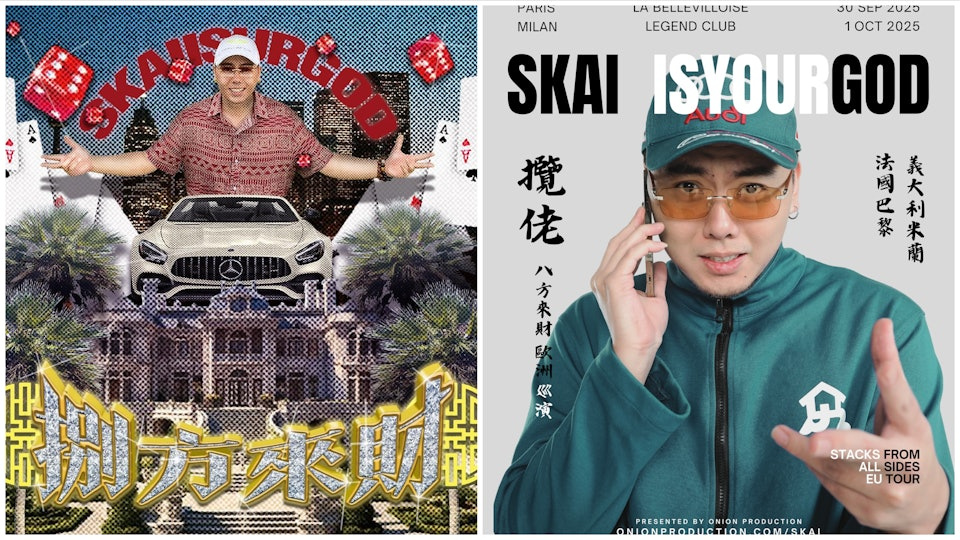
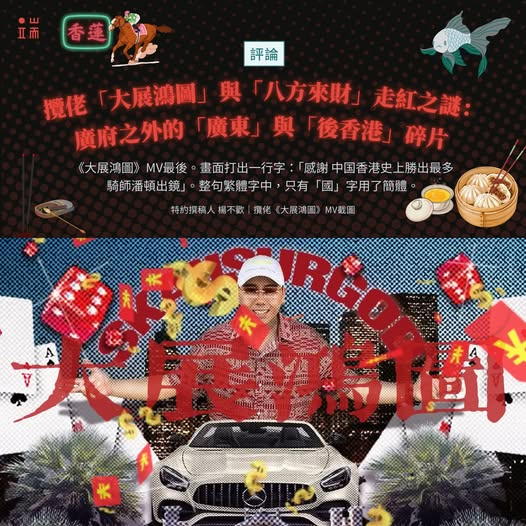
In 2025, a rap singer in the Chinese Mainland called “Skai Is Your God” (攬佬) who was born in 1998 became very hot. His most famous song is 大展鴻圖 (Spread Your Wings). He mixed his rapping with the song of the opera The Flower Princess known as 升天 (Ascend to Heaven). In a short time, the mixed song gains tremendous popularity and commercial success. It is so widely played online that the video has been watched almost 100,000,000 times. Like the “Ice Bucket Challenge”, the youngsters nominate one another to sing and dance to the song. Ascend to Heaven, a song more than 60 years ago, right now is a craze in China.
Cantonese opera is an old form of art and it is actually losing its audience, especially the younger generation, in Hong Kong. The rap song of Spread Your Wings accidentally triggers a “hit” of the opera in the Chinese Mainland. This craze points out how Cantonese opera in Hong Kong may launch a widely-embraced creative marketing campaign. The industry must learn how to craft compelling content, leverage the power of storytelling, and optimize public engagement and shareability. It must create something, a gimmick or not, that being easily shareable online, will resonate with the young audience. That thing must also provide a good topic so that the youngsters are eager to spread to other friends.
Effective marketing builds connections and creates value for the target customers. While shows are performed on stage, the branding of Cantonese opera must try to equally impress the mind of those below the stage.
This article can also be found at the following sites: