
Lives are measured by our number of years. Governments in the world treat citizens differently according to their age. The sadness of old age is often about loneliness and financial worry.
In 1958, a great Japanese film about life and death shocked the world with this disturbing story. It is called “The Ballad of Narayama (楢山節考)”. The story is set in a remote mountain village where food is scarce. The tradition dictates that senior villagers who have reached their 70th year must be carried by any family member to the summit of Mount Narayama. He or she will be left to die there so that the food in the village in the snowy winter can be saved for the younger ones. The character at the center of the tale is an old lady, Orin, a dignified and dutiful woman who spends her dwindling days securing the happiness of her loyal widowed son with a good new wife. After doing that, she is happy to be taken to death in the mountain. “The Ballad of Narayama” is an artistic, philosophical and touching work from Japan’s cinematic golden age, directed by the respectable Keisuke Kinoshita (木下惠介).
Some said that “The Ballad of Narayama” is the first film to discuss “euthanasia”. There are 2 kinds of euthanasia. One is for the relief from suffering such as stopping relentless physical pain that medicine cannot fix. The other reason is a personal choice. One may choose an earlier calm and timed death instead of experiencing a slow decline of health due to old age. There are cases that one plans to die in order to reduce financial costs for loved ones.
In Hong Kong, euthanasia is against the Law. Confucius said wisely, “You do not yet understand life—how can you understand death?” Death must be a natural and un-intervened course of life!
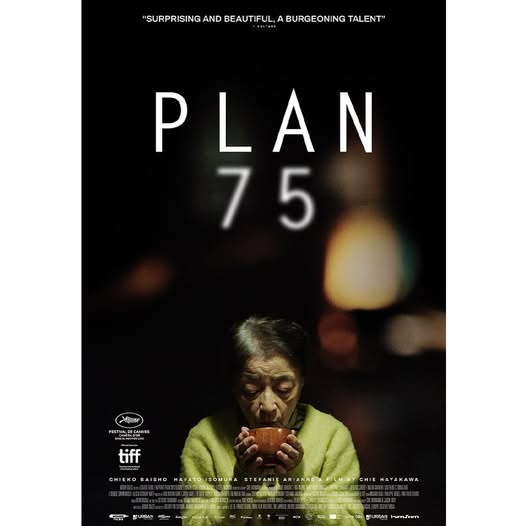
“Plan 75 (75終生計劃)” is a very thought-provoking dystopian drama film directed by Chie Hayakawa (早川千繪). It is regarded as the modern version of “The Ballad of Narayama”. It was selected as Japan’s official entry for the Best International Feature Film at the 95th Academy Awards. It tells the story of a fictional government program in Japan that offers a free assisted-dying package and financial stipend to citizens aged 75 and older. They are encouraged to end their life earlier so that the economic burden on society can be lessened. Michi, played by Chieko Baisho (倍賞千惠子), is a 78-year-old hotel housekeeper who loses her job and apartment. Having no family member to take care of her and the grave social desolation finally force her to see the government-based death program as her only practical option…
Chieko Baisho is acclaimed internationally for her naturalistic acting depth, emotional resonance and powerful lead performance in the film “Plan 75”. She gained prominent traction at the Cannes Film Festival in France. She plays that role of a moneyless, miserable old woman at the bottom of society quietly but intensely, with dignity but no trace of overacting.
J. K. Rowling once said, “To the well-organised mind, death is but the next great adventure.” So, should we see grief as the necessity of passing away? We live in a cold and apathetic world in which nobody cares about the elderly. Perhaps, shall we light up our hearts, and discharge the burden of death in our own way, with no trouble or sadness to others?
This article can also be found at the following sites: