
New ideas often spark creativity by challenging the status quo. But, new movie ideas often introduce risks that the audience may not like the strange ingenuity.
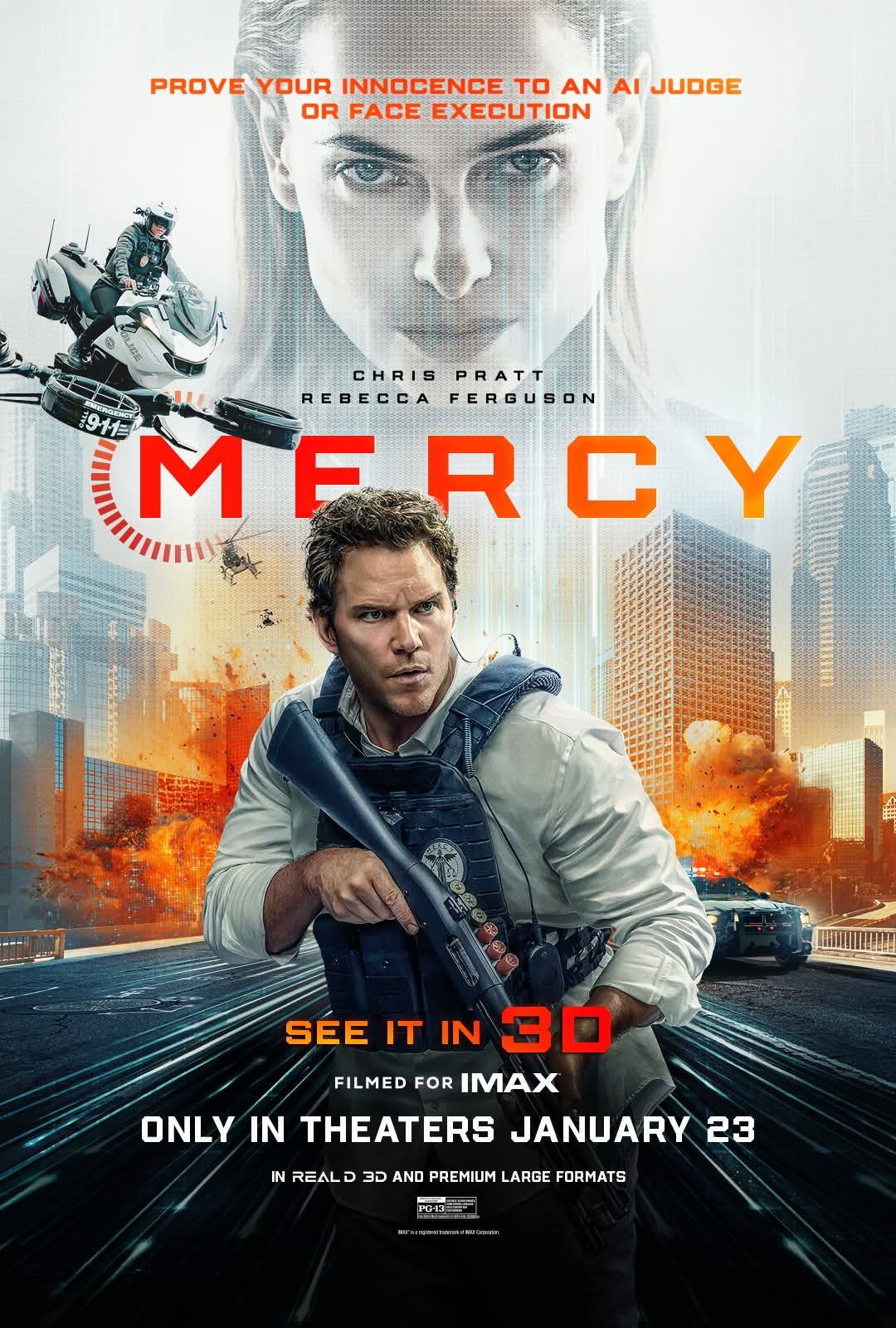
Legal drama Mercy (法無赦) is a 2026 movie which will evoke either a love or hate response. It is directed by Timur Bekmambetov who is Russian.
Bekmanbetov was born in 1961. He started his career in the 1980s as a theatre and film production designer. In 2021, he made an advertising commercial featuring Apple’s iPhone and this brought him international fame and recognition. Bekmambetov gradually moved his work base to Hollywood and became a successful film director. He is enterprising and his films are commercial.
The story of Mercy follows that a detective Chris Raven is accused of murdering his wife in a future police state and the judge is an “AI” female. Using the AI-judge named Maddox, the electronic judicial systems concluded a 97.5% guilt probability based on digital evidence, leaving Chris 90 minutes to prove his innocence or else he will face execution. In the AI-led state, the AI-controlled court expedites justice by serving as judge, jury, and executioner at the same time.
The trial is that the court will allow no human witness or documentary evidence. The judge will only search and ground in big-data computer evidence for a verdict. Here comes the problem with the movie. Chris and Maddox take the audience through hundreds of video clips from CCTV or internet. It also brings the audience to review loads of computer records. This is due to the fact that the AI-judge solely gets into and relies on the digital world. It ends up that during the film length of 2 hours, the AI-judge and Chris spend most of the time using a web browser to view content, social media and hidden cameras. They argue fiercely on such digital evidence. For me, such a long period of “net surfing” in a movie is definitely unbearable. I derive no pleasure from watching a movie through tons of video images which cram into the film.
Good movies should be natural and unpretentious. The formats should conform to the generally accepted rules. “You are still adrift while you still think that a means is an end.” Bekmanbetov may think a lot of CCTV video shots in the movie may amuse the audience. They are however no more than the means. The end must be that the director is able to tell the murder story in an emotionally engaging way. In this regard, he fails. The movie now looks like a social media website and it simply excites the youngsters. The weakness of this movie is that the story is cheesy and the characters are empty. The elaborative scheming of CCTV contents, in spite of the painstaking effort of the director, does not countervail the need for a well-balanced visual and dramatic variety in a film for the audience.
To create a new idea, a director does not have to use extreme means. Novel ideas carried to excess can be bad at the end.
This article can also be found at the following sites: